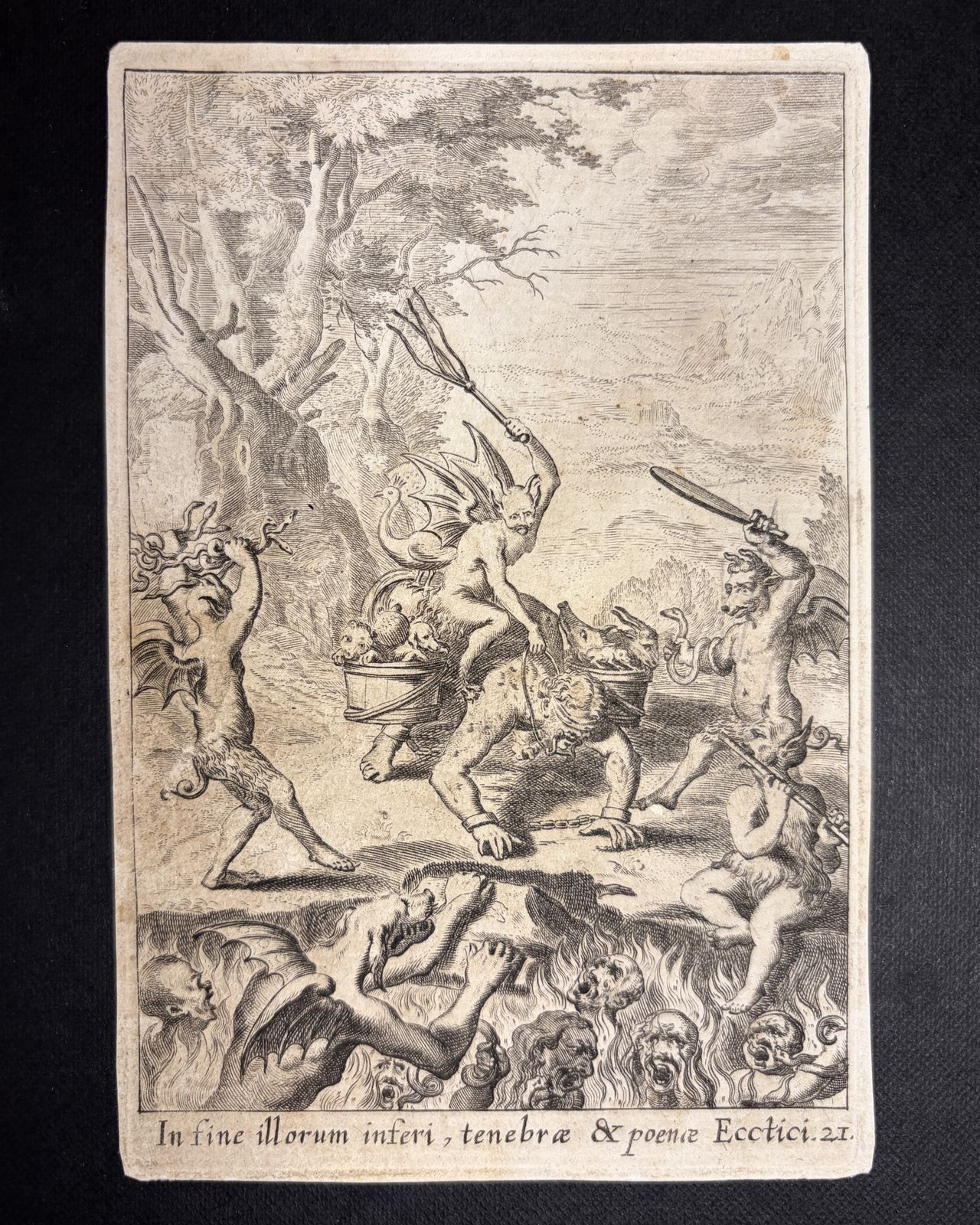
I’ve always felt that old things know more than I do. They were here long before me, and they carry what they saw into the present. Old prints especially. They were made to pass from hand to hand, and they still show how people pictured their world. They suit me for a practical reason, too. I travel a lot, rarely with luggage, and paper is the one thing that comes home with ease.
It started in Nice, with a bouquiniste and a pile of loose plates from Doré’s Divine Comedy, the Sonzogno edition, hell and all. I bought the lot, and every sheet came with questions I wanted answered. Imagery, historical context, underpinning beliefs. Medium, technique, edition, rarity. I started reading, and I haven’t stopped.
Most of the material I’ve been drawn to since centres on how people faced death, what they understood as sin and evil, and what they imagined waited for them afterwards. Much of it fed the fear. Hell’s mouth opens, devils and dragons close in, and giants and witches show where pride and a pact with the Devil lead. Some of it looked at death itself. The dance of death reminded its viewers that Death takes the pope and the ploughman alike, and the manuals on the art of dying, the ars moriendi, taught their readers to die well and without fear.
I look at all of this from the outside, with wonder at the worlds people built from these fears, image answering image, carried by prints across generations, and with the utmost respect for the hands that gave them form. For my part, I try to keep mortality in mind every day, not to frighten myself, but to remember that death and suffering come to everyone. The answer is to accept them and respect them. The dance of death comes closer to that than any vision of hell or its demons. Still, I collect both. One shows what people feared would come after death, the other death itself, and neither makes sense alone.
This is the collection I call Antiqua Macabra. Living with it and working on it is my own memento mori.
Because I’m after these images as people saw them, the collection holds only impressions printed from plates, blocks and stones worked by hand. That rules out photomechanical reproductions. The closer an impression is to the hand that made it, the better. Yet I live within my means, so I’m happy to start with a later impression and upgrade when I can.
Each entry here is my answer, so far, to a sheet’s questions: what it shows, where it comes from, and what kind of impression it is. I transcribe its lettering, examine the paper, and try to judge the quality of the impression. I compare it with examples held by museums and recorded in catalogues to see which state or edition it is. Where the plate and the impression differ in date, I give both. I cite only what I’ve checked, and I say where I’m unsure. When better evidence turns up, the entry changes.
The collection is private and not for sale, but always open to correction. If you know more about a print than I do, it would be a great pleasure to hear from you. Separately, I also collect Nordic material, because that’s home.
Björkman